

Why Portfolio Entrepreneurship Requires A Different Technology Model
SOLO HOLDER HQ GLOBAL MARKETS DIVISION
Research Series: The Open-Consult Global Market Thesis
Publication: Sovereign Portfolio Operating Systems (SPOS): How Regulatory Fragmentation and Geopolitical Instability Are Reshaping Enterprise Architecture
Classification: Long-Form Global Market Analysis Series
Distribution: Global portfolio operator network, investor community, enterprise leadership
This analysis represents the position of Solo Holder HQ Global Markets Division as of the publication date. Market dynamics, competitive positioning, and technology landscape are subject to change. Regular updates will be published as market conditions evolve.
PART I: THE PORTFOLIO OPERATOR INFLECTION POINT
Layered on top of regulatory fragmentation, geopolitical fragmentation, and cybersecurity fragmentation is a crucial development in enterprise organizations: the rise of multi-asset portfolio entrepreneurship as a dominant operational model.
A portfolio operator is an entrepreneur or business leader who simultaneously operates or owns multiple businesses, assets, and investments. This is distinct from traditional entrepreneurship (building one company) and distinct from traditional corporate management (overseeing divisions within one company). Portfolio entrepreneurship involves maintaining multiple legally distinct, operationally independent ventures that exist under one strategic ownership structure but require independent operational management.
Portfolio entrepreneurship has existed for decades. What has changed is its prevalence and its legitimacy as a primary business model and multi-generational wealth-building strategy.
Historically, portfolio entrepreneurship was either the domain of wealthy individuals creating personal holding companies or the accidental outcome of companies that acquired businesses and retained them as operating subsidiaries. It was not considered a primary business strategy. The dominant narrative was that entrepreneurs should focus on building one impactful business, that division of attention was weakness, and through that successful entrepreneurs became CEOs of large “Hyper-Scaler” enterprises rather than distinctive owners of multiple smaller enterprises.
This narrative has fundamentally inverted over the past decade.
Venture capital firms increasingly recognize that portfolio operators outperform single-company entrepreneurs and founders by a long-shot. Data from portfolio entrepreneurship studies shows that operators managing 2-4 businesses simultaneously generate higher returns than those building single company startups, have better risk-adjusted returns, and maintain higher sustainability through turbulent economic cycles.
The venture capital model itself—where venture firms maintain portfolios of companies rather than betting everything on single successes—has become the dominant shifting investment paradigm. It is not surprising that this approach has migrated to individual operators as well.
The rise of acquisition-driven entrepreneurship has accelerated this trend. Rather than building companies from zero, entrepreneurs increasingly acquire established businesses, integrate them into a thesis-driven portfolio structure, and inject value through operational optimization, cross-synergy pollination, and strategic brand repositioning.
Companies like Berkshire Hathaway have demonstrated that this model can scale to enormous success and create extraordinary value in the process. Smaller portfolio operators, managing 3-10 businesses generating $50-500 million in aggregate revenue, are increasingly more common than they used to be.
This shift creates a fundamental problem with traditional ERP architecture: traditional ERP systems are designed for single-company operations.
The assumption built into SAP, Oracle, Microsoft, and other enterprise platforms is that a single system serves a single enterprise. While these platforms technically support multi-company functionality, they do so by treating additional companies as divisions or subsidiaries of a primary company. The operational model assumes centralized decision-making, unified processes, and hierarchical governance.
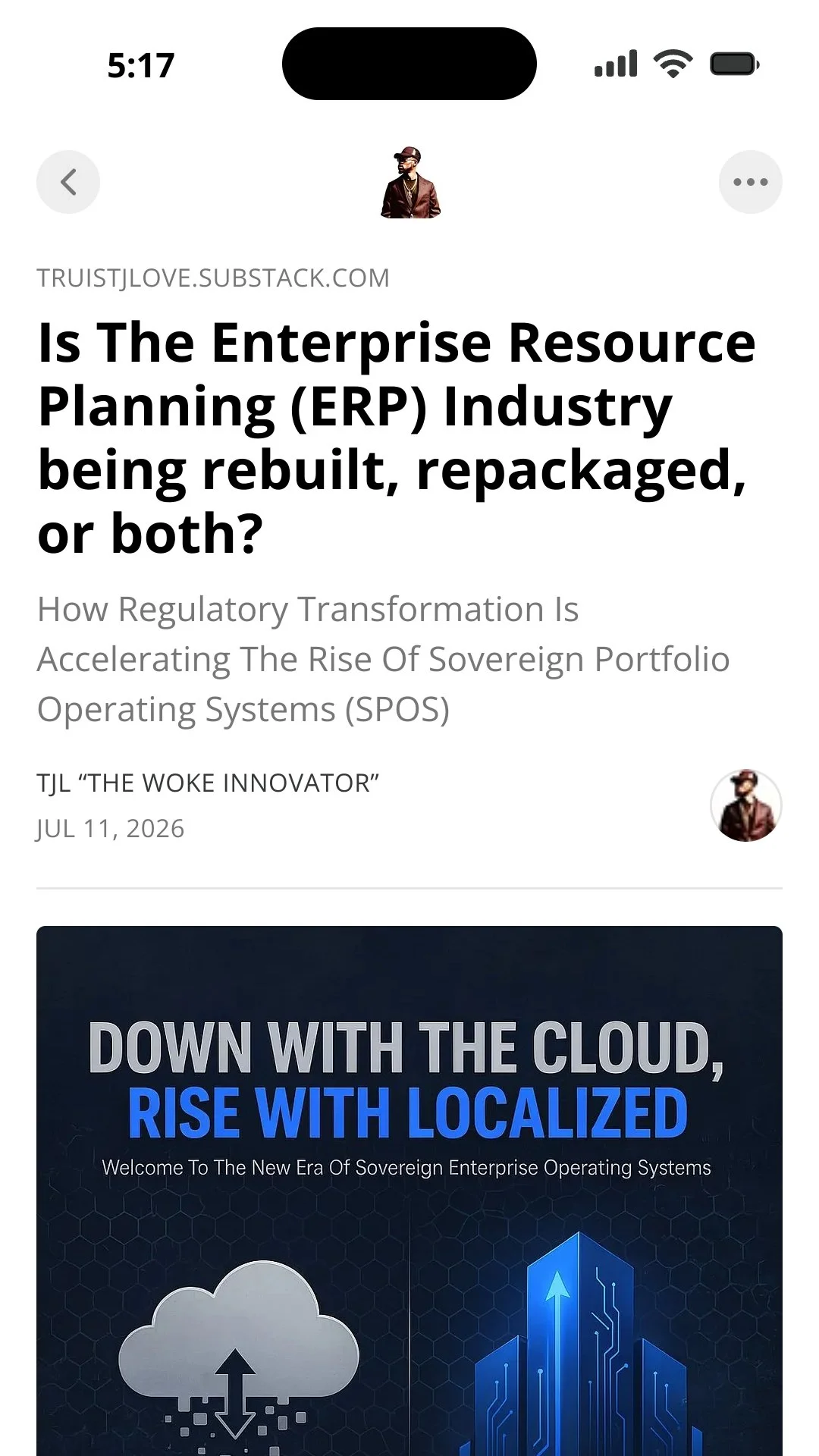
Solo Holder HQ however, uniquely understands something vital about his market shift which is: Portfolio operator requirements are fundamentally different from isolated or single-asset management solutions.
We know from over a decade of operational experience that Multi-Asset Portfolio Operators need:
Consolidated Intelligence Across Independent Operations. The portfolio operator needs visibility into aggregate financial performance, cross-portfolio risk exposure, consolidated cash flow management, and strategic portfolio performance. But this needs to coexist with Operational Independence of Individual Businesses. Each business operates with its own management team, its own customers, its own supply chains, and its own strategic priorities. The portfolio-level intelligence must not require compromising the independence of individual business operations.
Geographic Flexibility Without Architectural Constraint. Portfolio operators increasingly operate globally—businesses in the U.S., Europe, Asia, potentially across multiple continents. The technology infrastructure must support local data residency requirements in each jurisdiction, local compliance standards in each region, and potentially even local data processing and algorithmic governance. This is fundamentally incompatible with centralized infrastructure.
Economic Independence From Lock-In Vendors. Portfolio operators are increasingly sophisticated about technology investment. They recognize that perpetual subscription models create escalating costs that are difficult to model and plan for. They recognize that vendor lock-in prevents switching if vendor roadmaps diverge from operator needs. They increasingly want to own technology infrastructure as an asset rather than expense it as a subscription.
Algorithmic Transparency and Control. As AI becomes increasingly embedded in business operations, portfolio operators need to understand how decisions are being made, ensure that algorithmic systems align with operator values and strategy, and maintain the ability to modify or override algorithmic recommendations. This is fundamentally incompatible with vendor-controlled black-box algorithms.
Traditional ERP architecture can technically accommodate some of these requirements individually. But it cannot accommodate all of them simultaneously while maintaining the coherence and simplicity that made ERP attractive in the first place.
This creates a market opportunity for a fundamentally different approach and market provider to supply sovereign portfolio enterprise operating systems (SPOS)—one designed specifically for multi-asset portfolio operators, built around principles of operator control rather than vendor convenience, and architected for sovereignty rather than unanimous centralization.

Historical Infrastructure Waves That Led To Industrial Evolutions Similar To “SPOS”
The personal computing wave (1980-2000) created companies like Dell and Apple, which grew from flailing startups to tens of billions in market capitalization.
The internet wave (1995-2015) created companies like Amazon, Google, and Microsoft (in its cloud transition), which grew from small companies to market capitalizations exceeding $1 trillion.
The mobile computing wave (2007-2020) created Apple's iPhone division and Android ecosystem, generating hundreds of billions in revenue.
The cloud infrastructure wave (2006-present) created AWS, Azure, and other platforms generating tens of billions in annual revenue.
Each of these market shifts created 50-100x return opportunities for early investors in the companies that defined the new blue ocean wave.
SPOS represents the emergence of a new infrastructure industrial revolution—a fundamental shift in how enterprise operating systems are architected and controlled. The companies that successfully define this category will achieve valuations of $100 billion to $1+ trillion over the next 10-15 years.
Return Potential and Timeline
The investment return potential for SPOS pioneers such as Solo Holder HQ can be modeled relatively straightforwardly (Hypothetical Math Excersize):
Market Size Assumption: Serviceable addressable market of $50-75 billion annually by 2035 (based on 500,000-750,000 customers at $75,000-100,000 average revenue per customer)
Market Capture: A successful SPOS pioneer capturing 20-30% of this market (proportional to dominance of successful companies in other infrastructure categories)
Revenue Scale: $10-22 billion in annual revenue
Valuation Multiple: Enterprise software and infrastructure companies are trading at 8-15x revenue multiples in mature markets (somewhat lower than peak valuations but reflecting more realistic normalized multiples)
Enterprise Value: $80-330 billion
Return Multiple: For a company raising $50-100 million in Series A funding at a $250-500 million valuation, reaching $100+ billion in enterprise value represents a 200-2000x return.
This return potential is not speculative. It is based on historical precedent in previous infrastructure waves and on fundamental market economics driven by the addressable market size, average revenue per customer, and valuation multiples typical of infrastructure software companies.
The timeline for achieving this return is 10-15 years—a longer timeline than some venture capital investments target, but not inconsistent with infrastructure-category investments which typically require longer development and market penetration cycles.

PART II: SOLO HOLDER HQ'S POSITIONING IN THE “SPOS” CATEGORY
Why Multi-Asset Portfolio Entrepreneurship Is The Right New Industrial Foundation For Founders and Wealth-Builders Alike
Solo Holder HQ's entry into the Blue Ocean SPOS market begins with a particular insight: portfolio entrepreneurship is not a niche segment requiring a specialty product feature—it is a fundamental shift in how enterprises are fundamentally re-organized and restructured entirely, that will need an operating system architecture that is designed specifically for this new model, market, and asset class. - Truist J. Love
Traditional ERP vendors have attempted to serve portfolio operators by adding "multi-company functionality" to existing enterprise platforms. This approach is fundamentally constrained because it attempts to repackage a platform architecture designed for single-company operations to accommodate portfolio requirements instead of distinctively empowering them. It doesn't work well because the assumption of unified corporate control, unified processes, and consolidated infrastructure is built into the foundational outdated and unreliable architecture.
SPOS, by contrast, is designed from the foundation for portfolio operator requirements. From enterprises, to organizations and governments, This creates several new undeniable competitive advantages:
Architectural Coherence: Rather than grafting portfolio features onto a centralized architecture, SPOS is built with portfolio governance as a first-class architectural principle. Operational independence, consolidated intelligence, and portfolio coordination are native to the system rather than bolted on.
Sovereignty by Default: Rather than attempting to retrofit data sovereignty and operator control into a system designed around vendor control, these principles are foundational. The architecture assumes that operators own infrastructure, control algorithms, and maintain independence.
Go-to-Market Alignment: Rather than attempting to sell $50 million enterprise systems to portfolio operators with $50-500 million in aggregate revenue, SPOS pricing and deployment timelines are aligned with portfolio operator economics and decision-making processes.
Competitive Advantage Preservation: Rather than consolidating all portfolio data into a vendor-controlled system where algorithm development and competitive advantage accrue to the vendor, SPOS is designed so that competitive advantage remains with the operator.
Solo Holder HQ's Current Trajectory
Solo Holder HQ's foundation is built on multi-asset portfolio entrepreneurship—specifically, the business succession and acquisition market amidst the “Largest wealth-transfer in economic history” currently taking place—positions our company effectively to incubate and expand into the broader SPOS global industrial market.
The business model works as follows:
Portfolio operators—aging business owners looking to exit, next-generation operators looking to build, acquire, or sell established businesses—represent a specific segment of the broader portfolio operator market. These operators need specific capabilities: exit planning, business valuation, acquisition sourcing, capital financing solutions, post-acquisition integration, etc.
By building these capabilities specifically for this segment and achieving market leadership in business incubation, succession, acquisition, and transition Solo Holder HQ establishes ourselves with:
Deep expertise in portfolio operator market requirements
Customer relationships with portfolio operators across multiple geographies
Understanding of portfolio operator economics and decision-making
Credibility with this specific customer segment and market niche
From this foundation, Solo Holder HQ will expand into the broader global SPOS market, adding capabilities that serve portfolio operators more broadly and directly than ever before.
This Blue Ocean exploration path mirrors the expansion of successful infrastructure companies in previous market shifts. AWS started with compute and storage infrastructure. It has expanded into dozens of services addressing nearly every aspect of enterprise infrastructure. Similarly, Solo Holder HQ will expand from portfolio succession into the broader SPOS market by adding capabilities that address the full range and lifecycle of portfolio operator requirements.
Why Solo Holder HQ Wins This Category
Solo Holder HQ's advantages in competing to define and dominate the NEW SPOS market category are substantial:
Operator-First Foundation: Built by portfolio operators for portfolio operators, the product development is driven by actual operator needs rather than vendor assumptions about what operators should want.
Architectural Sovereignty: Designed from the foundation around operator control and data ownership, rather than retrofitting these principles into a centralized singular cloud architecture.
Regulatory Alignment: Built for diverse regulatory environments defined by data sovereignty and operator control requirements across global jurisdictions, which means compliance becomes a. operational advantage rather than a administrative burden.
Pricing and Economics: Structured around operator economics ($50,000-$200,000 annually) rather than enterprise software economics ($10-50+ million), which aligns with how portfolio operators think about ROI within technology investments.
Geographic Flexibility: Designed for global operations across multiple jurisdictions with different regulatory requirements, which addresses a core pain point for existing global portfolio operators.
Competitive Advantage Preservation: Designed so that operational intelligence and competitive advantage remain with the operator, which means operators have incentive to invest more deeply into platform capabilities.
Market Timing: Entering the market at the inflection point when regulatory requirements are tightening, geopolitical fragmentation is increasing, and portfolio entrepreneurship is accelerating as a business model across the world.
The combination of these advantages positions Solo Holder HQ to emerge as a market leader in the SPOS industry, achieving the kind of dominant and defensible market position that becomes the foundation for the next $100+ billion enterprise value.
CONCLUSION: THE INVESTMENT IMPERATIVE
For portfolio operators reading this analysis: The technology you use to manage your operations will determine your competitive advantage, your strategic flexibility, and your ability to navigate an increasingly complex regulatory and geopolitical environment. If you are managing your portfolio through technology infrastructure you do not control, operated by vendors whose interests may not align with yours, you are building your competitive advantage on someone else's foundation. The time to transition to infrastructure you own is now.
For investors reading this analysis: The companies that successfully build Sovereign Portfolio Operating Systems will achieve valuations of $100+ billion within 10-15 years. The investment window for entering this category remains open. In 3-5 years, dominant players will emerge and the opportunity to achieve outsized returns will have largely closed. The time to position within this category is now.
For enterprise software leaders reading this analysis: The market dynamics that enabled centralized, vendor-controlled enterprise systems are no longer present. The future will be increasingly hostile to vendors built on lock-in and switching costs as organizing principles. Organizations built around operator ownership and sovereignty will dominate. The time to fundamentally rethink enterprise architecture is now.
The next era of enterprise technology is not being written by vendors that build better versions of yesterday's systems.
It is being written by organizations that understand why the world has changed and are building infrastructure for the world that is emerging.
